
On Sea-Steading, God, and Oar Power
Fans of my YouTube channel How to Sail Oceans have suggested that I write a book. I’m reasonably sure that they mean a sailing book, an adventure log.
The truth is that I am really not interested in the project, perhaps because I secretly regard the project as beneath me. Does that make me a literary snob?
It’s just that I cannot think of anything I might add to this well traversed literary genre. Nowhere have I sailed that has not already been visited by a yacht. I’ve read the classics, from Joshua Slocum to Bernard Moitessier to the Pardey’s. All of these individuals have navigated without electronic aids–by sextant, compass, sounding lead and taffrail log. All of them have made their way across oceans, in and out of bays, negotiated yachting centers and commercial ports without auxiliary power. While I am quite the rarity these days as a purist (engineless) sailor, nonetheless, it has all been done before, and it has all been written up.
Well while I am at it, at making confessions that is, I may as well say that I haven’t even grazed let alone immersed myself in yachting literature for a good two decades now. Truth be told, I don’t watch many YouTube sailing videos either. I find most of it dull. There, I said it. “We have quit our jobs and bought a boat and now we are living our dream of sailing around the world … ” While such a thing may be of epic proportions to you personally (as it should be), the fact is that, to repeat, so many people have done and are doing exactly the same thing that it’s no big deal anymore.
Are you still with me? Please don’t leave just yet, because there’s more to this story.
So there I was working on my sturdy little craft, minding my own business, when this fellow on the boat next to me in the boatyard hands me a book he thinks I should read. He seems like an intelligent young man based on the short conversations I’d had with him up to this point, so perhaps that was enough to persuade me to politely accept the gift. But then a week later he says that he wants the book back as he will launching soon to set out on his own sailing odyssey. Amazingly I had actually found the motivation to flip through the first few pages and some things caught my eye. This book was something out of the ordinary. Now curious I ordered my own copy off of Amazon.com. I crammed the newly delivered book into my onboard bookshelf where it lay uncracked for the next two years.
Another question I frequently get is whether I’m thinking of buying another boat, meaning, of course, a bigger one. The answer is no and for two reasons. One is that I have spent so much time modifying and tuning my own craft to suit my needs that I don’t particularly relish starting the process all over again. The second reason is that I like my boat. That said, I am not immune to temptation. One temptation I’ve entertained is finding an old William Atkin designed Ingrid, or her sororal twin the Alajuela 38, remove the engine and re-fit her with a gaff rig. So basically just a bigger version of my own boat, Ruth Avery. I’ve sailed on an Alajuela 38, and they are amazingly swift. Which is not surprising as the lines of this craft are near perfection.
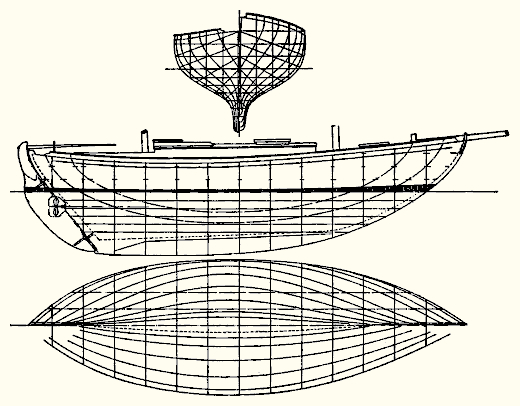
I said that a few things caught my attention when I first flipped through Sea-Steading, the book by Jerome FitzGerald, the loaner book from my boatyard neighbor. Mr. FitzGerald purchased his boat Macha as a partially completed Ingrid “complete with pilot house, rotten decks, and bat colony”, and then proceeded to rebuild her, giving her a traditional gaff rig and removing the engine. With every passing year I become more convinced that there is a supreme intelligence at work who likes to tease.
Which Mr. FitzGerald does not believe in. He establishes himself at the outset as a hardcore, militant atheist of the Richard Dawkins variety. I don’t like Richard Dawkins. I think he is egregiously mistaken about the most important things. Yet Mr. FitzGerald is at the same time an eerily kindred spirit to me. In the dedication he writes: “This book is dedicated to those who sail and appreciate the beauty inherent in sailing. This book is dedicated as well to promoting the skill, character, and seamanship displayed by those who sail in its traditional fashion–without the aid of engines. This book affirms the rigors of true sailing–the attentiveness they demand and the strength they contest–as rewards. This is what makes the experience meaningful. We cannot imagine demeaning our experience by making it trivial or common.” [1]
Preach, brother.
Another little bit of irony is that the name of the boat belonging to the fellow who lent me this book is Cloud Messenger. Mr. FitzGerald would probably call it coincidence, or Dawkins would probably say that I am reading in design where only chance exists. I’m not so sure of that.
The New Smart-Aleck’s
Let us address our disagreements straight away. Mr. FitzGerald writes: “We only have meaning in our life insofar as we create meaning. Meaning is nothing more than what can be termed ’emotive import’, or a fancy way of saying the ‘event at hand makes me feel’ … We only notice, are conscious of, the emotion of the moment [1](p. 11) … [The problem of human suffering] has been a problem for mankind forever, of course, and the religions of the world have tried to confuse the basic issue of the fact … [and offer] all sorts of mental tricks that are taught to blunt the edge of reality … [like] otherworldly justice at some fictitious point in the future … Imagine that if mankind had faced squarely the issues of the difficulty of life for ten centuries rather than trying to evade them, where we might be today? … I have come to the conclusion that more than what one believes or the ethical system one holds, the environment in which one lives in has more of a bearing on how one views the world … A bad environment, and desperation in general, make one tend to grasp at any hope, and one is likely to find god.” [1] (p. 31)
I hope that I have fairly encapsulated Mr. FitzGerald’s worldview in the above medley of quotes. He explicitly identifies as a humanistic atheist, and so I shall invoke a well-known proponent of this view, Richard Dawkins, for further examination.
Mr. FitzGerald regards religion as a cope. Richard Dawkins, who would agree with that assessment, sees religion as a by-product of evolved traits which benefit, or have benefitted, humans in some way. He puts forth the theory that unquestioning obedience to authority is frequently necessary for humans, as our instincts are sometimes woefully insufficient, which is obvious in the case of curious youngsters. When dad says don’t play by the riverbank because there are crocodiles around, the child is well served to obey without question. Should the father, on the other hand, insist that as a child of the Enlightenment he should seek out truth on his own, unfettered by convention and prejudice, that he should eschew any rote learning and dogma, that could well end the boy’s life before it even began.
Dawkins goes on to put forth his theory of memes, which essentially are useful or appealing cultural beliefs or expressions. Religious stories and aphorisms have proved especially meme-worthy because they speak to uniquely human psychological needs: the need to believe that our suffering matters, that there is a greater power underwriting a moral order to the universe, that those who have wronged us will pay for their crimes even if they escape justice here on earth, etc.
Thus according to Dawkins we are primed for religious indoctrination by our evolved trait of respecting authority and accepting conventional wisdom, and that successful religions have developed memes (parables, stories, etc.) which speak to basic human psychological needs and as such are used by religious authorities get us hooked on their “copium”. And to Mr. Fitzgerald’s point about the environment, surely religious memes spread better in some environments than others: people in distress are more likely to find God–there are no atheists in foxholes as the saying goes.
Dawkin’s says that religion is a “mis-firing” of evolved brain mechanisms which served us in the past, and may still serve us particularly when we are young and inexperienced, but that make us vulnerable to indoctrination, to fanatical adherence to irrational beliefs.
If this is in fact the case, obviously mankind needs to grow out of it. In the words of physicist Stephen Weinberg: “The world needs to wake up from the long nightmare of religion. Anything we scientists can do to weaken the hold of religion should be done, and may in fact be our greatest contribution to civilisation.” [2]
Speaking specifically to the Judeo-Christian worldview, Dawkins writes: “The God of the Old Testament is arguably the most unpleasant character in all fiction: jealous and proud of it; a petty, unjust, unforgiving control-freak; a vindictive, bloodthirsty ethnic cleanser; a misogynistic, homophobic,homophobic, racist, infanticidal, genocidal, filicidal, pestilential, megalomaniacal, sadomasochistic, capriciously malevolent bully. Those of us schooled from infancy in his ways can become desensitized to their horror.” [3]
So not a fan. Given this perspective on the matter we can understand why Dawkins and his ilk are so militant in their atheistic proselytizing. They are trying to save humans from some really, really nasty and destructive lies.
But, we must ask, what of their arguments? Is Judaism and Christianity nothing but a lot of fanciful stories to help us cope? Are people of faith simple fools?
What Does ‘2’ Weigh?
Thinkers like Dawkins believe that for anything to count as knowledge we must be able to set up a science experiment to verify the claim. If Dodo birds still exist, then at some point we should able to find one, catch him on camera. So why not apply the same standard to God? Dawkins writes: “Either [God] exists or he doesn’t. It is a scientific question; one day we may know the answer, and meanwhile we can say something pretty strong about the probability.” [3](p. 70)
Really?
Dawkins and company are scientific materialists. They believe that reality is what the physical sciences describe: elementary particles and energy, chemical reactions, biological evolution of life forms through natural selection. Which is probably what most people believe these days. So let us pose a philosophical question: what is the mass of ‘2’? What is its chemical formula? What space does it occupy?
Suddenly we are confused because numbers are mind-stuff, not physical entities. Since the scientific materialist insists that everything is reducible to matter and energy, “mind-stuff” must therefore be an epiphenomena of underlying material processes. As Dawkins famously argues regarding living creatures, they only appear designed. Design is just a figment of our own imaginations, and our imaginings are in fact just physical processes taking place in our brains, and our brains are the result of undirected material processes over long periods of time. With regards to a number like ‘2’, the scientific materialist might contend that we have to think about ‘2’, which means that our mechanical brains are doing something. So ‘2’ is thus always reducible to brain activity, and therefore to the physical and observable.
OK then, what about ‘12,334,556,129,343,445,443,392,007,444,233,556’? (I just made that up) or some such random gigantic number? Since there are an infinite number of integers there must be an infinite number of them at any given time which no one is thinking of–i.e. there’s no brain activity corresponding to it–and which exist on no computer hard drive or written on paper or anything anywhere in the universe. So they have nothing physical to be reduced to. I repeat the question: do these numbers exist?
Or consider the physicist claiming that elementary particles are the fundamental building blocks of the universe. Well he could not mean that all observed reality is reducible to the physical reality physics describes, otherwise, what is the description itself? What of differential equations, numbers, mathematical operators, etc.? Certainly they are not made of elementary particles, have mass or energy, occupy space. Quantum Field Theory is something you understand (or at least a few people do, or claim to … ) not something you observe in nature, touch, feel, or taste.
The indisputable fact is that we cannot know anything at all without thinking, and thinking is not anything material in the scientific sense. CS Lewis famously wrote: “The Naturalists have been engaged in thinking about Nature. They have not attended to the fact that they were thinking. The moment one attends to this it is obvious that one’s own thinking cannot be merely a natural event, and therefore something other than Nature exists.” [2](p. 49)
Mind, consciousness, soul–whatever you want to call it–is the most basic substrate of any kind of reality that we can be made aware of (that is not to say that there is nothing beyond thought, only that we cannot know it). It is a peculiar claim indeed that what the products of mind reveal, e.g., the elementary particles of quantum physics, are actually real while the mind itself is some sort of epiphenomenon or illusion.
The Problem of Self-Serving Barbers

So we agree that a soul, let’s call it, is necessary for knowing anything, and in particular it is the human soul’s capacity for reason which produces anything we can call knowledge. The central article of faith of science is that all truths–or at least all the important ones–can be known through reason. It is therefore of paramount importance to scientists to know that they are in fact reasoning correctly. To this end philosophers throughout the ages have developed formal systems of logic, beginning most notably with Aristotle. Perhaps the most ambitious of such systems is Betrand Russell and Alfred Whitehead’s prodigious Principia Mathematica, which they published in three volumes between 1910 – 1913.
All formal systems of logic start with a set of axioms and have specified rules of inference. Any statement derived from the axioms using the rules of inference will be a theorem of the system. So long as the axioms are true, all derived theorems are guaranteed to be true. The hope of Russell and Whitehead was that all mathematical and scientific statements could be cast as statements within Principia Mathematica. In which case one needs merely to crank the machine and out comes guaranteed truth. Science will no longer be marred by error. The pure light of truth will eventually shine upon all of nature’s mysteries.
This was a grand vision but as you might guess not so simple to implement. Additionally, one very pesky problem emerged in that Principia Mathematica could produce theorems that talked about themselves. Russell offered a folksy example of this problem in asking us to imagine a village barber who shaves all men in the village who don’t shave themselves. The statement seems perfectly innocent until we think about it. Our village barber, let’s call him Burt, shaves all the men of the village who don’t shave themselves. All fine and good until we realize that Burt is a man living in the village and we must determine whether or not Burt shaves himself. If Burt does not shave himself, then there is one man in the village who Burt doesn’t shave and who doesn’t shave himself, which makes our statement false, since Burt is the village barber who shaves ALL men who don’t shave themselves. So the obvious fix is for Burt to shave himself. But then we realize that Burt is now shaving a man who does shave himself, making the statement false once again. Bugger.
Nonetheless Whitehead and Russell believed that they could inoculate their magisterial truth machine against such subversive self-referencing. That was until a young Austrian mathematician named Kurt Godel came along. Godel noticed a parallel between recursive arithmetic systems and formal logical systems. A simple example of a recursive arithmetic system is the Fibonacci numbers: 1,2,3,5,8,13,21,34,… which is a series of numbers produced by the recursive formula Fn = F(n-1) + F (n-2), n > 2, or the nth Fibonacci number in the series is the sum of the previous two F numbers. Notice that we need the first two numbers, 1 and 2, to get us started. Those are the “axioms”, from which all “theorems” (successive) Fibonacci numbers are derived. In fact Godel would come to realize that the entire system of symbolic logic put forth in Principia Mathematica could be encoded as an arithmetic system like Fibonacci numbers, only more complex. This would become the famous Godel numbering system.
Perhaps a concrete example of a formal logical system and Godel numbering would help here. To this end, Douglas Hofstader has provided us with his simple MIU system [4], which is constructed from three typographical characters, M, I, and U. The system has one axiom: MI, and four rules for constructing theorems:
- Any string ending in I can be replaced with IU.
- Any string of the form Mx (x is any string of characters) can be made into Mxx
- III can be replaced with U
- UU can be removed
Now, for example, we can ask: Is MUI a theorem?
Proof:
- Start with our axiom: MI
- MII (rule 2)
- MIIII (rule 2)
- MUI (rule 3)
QED
Now consider a parallel system made of three whole numbers, 3, 1, and 0. This system has one axiom: 31, and four rules for construction:
- Any number ending in 1 can be multiplied by 10
- Etc.
Unfortunately, the remaining rules get quite complicated, but it is only important to note one thing here: 3,1,0 directly corresponds to M, I, and U, respectively. Notice that the first rule of MIU says that any string ending in I can be replaced with IU. So our axiom MI can be turned into MIU by the first rule. Correspondingly, our axiom 31 can be turned into 310 multiplying by 10, which is the first rule of the corresponding arithmetic system. To repeat the point: to our formal symbolic system we can construct a corresponding arithmetic system, where all the rules of our symbolic system are mirrored as arithmetic operations.
The other important takeaway is that formal logical systems don’t have to mean anything. They just start with a vocabulary of symbols, some axioms, and rules for producing theorems from those axioms. That’s it.
But of course the whole point of Principia Mathematica was to produce meaningful truths, to purge science of messy, sloppy, ordinary language and cast its propositions in terms of unassailable formal logic. It was Kurt Godel who realized that this alignment with truth– with meaningful statements in ordinary human language– would be Principia Mathematica‘s undoing.
So the hand-waving explanation of Godel’s famous incompleteness theorem is this: Godel, using Principia Mathematica, constructed a statement which says (in ordinary language): “when fed its own Godel number, this statement cannot be proved using the rules of Principia Mathematica“. Or: k = G(x), where k is the Godel number of the statement in quotes, G(x), and x is an independent variable. So when we feed G(x) its own Godel number, we have: g = G(k), where g is the Godel number of G(x) when x is assigned the Godel number of that statement. Now in practice g will be some whopping gigantic number, but we can ask: can g be reached using Principia Mathematica, using the axioms and rules, but cast in arithmetic form? Just as we can ask: is 334564 a Fibonacci number? Either it is or it is not.
The devilish detail is that if g can be found, then G(k) is a theorem of Principia Mathematica. Except that G(k) says that it is not a theorem! So finding g means that we have found a proof of a theorem which says that it is not a theorem.
Well we can’t have our great truth machine proving contradictions, so the only way out is to posit incompleteness, that there will be at least one theorem which can be stated using the system–and which we understand is true– but which cannot be proved. By extension every formal logical system will have this property: to avoid contradictions, they must remain incomplete. The big takeaway: we humans, in understanding Godel’s statement in ordinary language, what it means, understand that whatever formal logical truth system we can construct will have at least one TRUE statement that WE UNDERSTAND as true but which cannot be proved by the system– it cannot be computed, it cannot be “known” by system. Or that human understanding transcends any system of formal logic.
Again the problem is with self-referencing. For example, in Principia Mathematica we could have a statement k = PRIME(x), where k is the Godel number of the statement asking: is x a prime number? Well nothing prevents us from writing: g = PRIME(k), which asks: is the Godel number of the statement PRIME(x) itself a prime number? As before, our machine will search to find if g is a theorem, or if g is true, which, if so, means that k is a prime number. Maybe it is, maybe it isn’t. In either case an interesting tidbit of information to add to the Principia Mathematica knowledge library.
But what got our knickers all in a bunch was the statement g = G(k), which says that there is no proof of this statement (i.e. g is not a theorem) when x is set to the Godel number of G(x).
Actually, just for kicks, let’s consider g = NO_PROOF(PRIME(x)), which states that there is no proof of PRIME(x) when x is set to the Godel number of the argument (what’s in parenthesis). Now PRIME(x) will have a Godel number p, so let’s sub p for x to get NO_PROOF(PRIME(p))= g. If the Godel number of PRIME(x) is in fact prime, then g will be false, there will be a proof that p is prime because it is. Otherwise g will be true–we will find this Godel number can be generated by the arithmetic analogue of Principia Mathematica. So all fine and good. No problems, no contradictions.
Now comes the Godel trick: instead of subbing in PRIME(x), let’s sub in NO_PROOF(x). Now the statement NO_PROOF(x) will have a Godel number k, so NO_PROOF(NO_PROOF(k))= g. NO_PROOF(k) will have a Godel number g‘. So we have g = NO_PROOF(g’). What is g’? The Godel number of NO_PROOF(x) when x is set to the Godel number of the statement NO_PROOF(x). Recall Godel numbering: to our system of formal logic, we have a parallel arithmetic system, so that every line of a proof in Principia Mathematica can be expressed as a number. So g’ is the numerical way of saying: “there exists no proof of NO_PROOF(x) when x is set to the Godel number of that very statement”. Therefore what the statement g = NO_PROOF(g’) is evaluating as its argument (what’s inside the parentheses) is the very statement itself when expressed numerically (as its Godel number).
Again, in order to avoid contradiction, g cannot be a theorem of Principia Mathematica, or the Godel number g cannot be found, otherwise we would have a contradiction since the statement says it is not a theorem.
I know this is quite the brain teaser. I here supply references to a video series which I think explains Godel’s incompleteness theorem quite nicely. [4][5][6][7][8]
Anyway, the big takeaway from all of this is that Godel’s theorem implies that human understanding is not reducible to a computation. We understand that if the Godel statement is proved, then the system is proving a contradiction–and that that understanding cannot come from within the system. For any formal logical system we can create, there will be at least one truth which we understand as true but the system does not. Understanding has the property of always standing outside of its objects. What the Godel theorem shows is that should we try to turn our understanding into an object—to create an artificial intelligence—our understanding of it will yet place us outside of what our created intelligence understands (or can prove).
Or as Roger Penrose — philosopher, mathematician, and, ahem, Nobel prize winning physicist — puts it: “What the Godel theorem does [is that] it tells you how to use your understanding of why the rules are true to transcend the rules … the point is that [the formal logical] system doesn’t know what it’s doing, that’s still true with AI, you talk to AI and it doesn’t know what it’s talking about.” [9]
The difference between consciousness and what a computer knows is that the former lives in an ocean of potential–potential objects to be brought forth into conscious awareness. Our reality is in this respect created, or reasoned out from this vast, unfathomable potential. Notice how this parallels the creation story of the world in Genesis: “Now the Earth was formless and empty, darkness was over the surface of the deep, and the Spirit of God was hovering over the waters”. God then creates our world, creating day and night, land and sea, and so on. He creates a habitable order by speaking, thus creating a world that can be rationally understood. The human soul is an attenuated version of its Creator, as we similarly can create our own worlds (e.g. through technology) through our understanding of God’s creation and our own creative capacity.
We Can Only See Valuable Facts
So we’ve established that there is this indefinite ocean of possible things in what we call consciousness. From which it follows that objects of knowledge must come into our awareness by some sort of filtering process. The philosopher Imanuel Kant posited that all propositional knowledge is made possible through the Categories of the Understanding. One category, for example, is Quantity. Take an apple. Every apple is different, but there’s an intersection of common characteristics which allows me to determine it as a unit of “apple-ness”, and once I have resolved how to determine an apple, I can then count: one, two, three, four, five! I have five apples in my bag. This is important to me because I can sell these apples for $0.25 each. All prospective buyers also know how to resolve apple-ness and how to count them, hence the number of apples for sale is “objective knowledge”, something that can be placed in the public domain of things we all see or understand in the same way–things that are not merely subjective opinion. The important thing to note here is the abstracting of “apple-ness”, that we filter and resolve experience, not merely observe given facts. Which is to say: objects in the world of which we can have any knowledge of cannot exist without the organizing agency of the soul (or mind, if you prefer).
Let’s explore this a little further. As I was walking to the marketplace with my bag of apples, summing up in my mind how much money I would make, I notice a fellow in front of me suddenly get agitated, pull out a pair of binoculars and then dash into the bush. I am momentarily distracted by him, puzzled by his behavior. We later meet up at the market and talking to him I find out that he is an avid bird watcher, and that he veered off the road because he heard the song of a very rare bird. I know nothing of birds. I cannot even recall hearing bird noises. My mind was occupied with the potential profit from my apple haul. For me the bird didn’t exist at all because my conscious perception was never attuned to it. And that is because bird calls are not something I value.
Thus we are beginning to see how our values determine the reality which reveals itself to us. This undermines the empiricist view of “ready made” objects in the world which our senses merely detect.
If we adopt the empiricist view, then it follows that at some point everything will be revealed, we will have shined the light in all possible places and know what reality is in its totality. Theoretically science has an endpoint, at time when all of the facts are accumulated, the heavens are mapped, laws of motion for all things great and small are known.
But the history of empirically based modern science itself betrays this view. Newton and Einstein, for example, were both looking at the same planets, moons, and stars when Newton very accurately described gravity as an innate pulling force between two masses whose strength is proportional to the inverse square of the distance between them. Einstein then reimagined the workings of the entire data set, claiming that masses are actually traveling in straight lines but in a space that is curved by mass. The elliptical orbits of planets are just like ships following great circle routes across the seas – they are always pursuing the shortest distance between two points. Revolutions in science involve and are sometimes exclusively revolutions in thought which re-imagine and reorganize human experiences of the world, a point famously made by Thomas Kuhn in his book The Structure of Scientific Revolutions in what he called paradigm shifts.
The point here is that scientific theories and scientific facts involve the agency of the mind, or soul, and that whenever we speak of the agency of the soul this necessarily means moving toward some state of affairs it sees as better than the present. Kuhn said that scientific paradigms have two defining characteristics: 1.) They are “sufficiently unprecedented to attract an enduring group of adherents” away from what has been going on. And 2.) they are open-ended, with plenty of problems for the “redefined group of practitioners to resolve.” [11]
In other words, new scientific paradigms come to be because they are novel and interesting. Scientists don’t wander out into nature and haphazardly measure things just for the hell of it. Facts are gathered as part of an investigation, piecing together the clues of a mystery.
So the facts revealed to us by science are brought forth by human interest in novelty, the lure of a good mystery, the challenge of solving a puzzle. But how are we to understand this interest, what we sometimes refer to as “a calling”? Jordan Peterson, often citing Carl Jung’s work, argues that it is archetypal stories which reveal the most basic human values. He writes: “What could possibly be more real than the facts? First, which facts? And there indeed is the rub. This is why we find the archetypal stories at the base of every well-integrated psyche and every unified community. These stories provide the structure through which we apprehend the facts and communicate the hierarchy of value that lends weight to one fact over another. The great stories reflect the aim that motivates us and provides security to the individual, and which when shared constitutes the basis for community. That aim is a prerequisite to the act of perception that allows us even to encounter what most truly exists. The stories that are depictions of our aim and our character have a primary reality, not least because even our understanding of the real—even our “direct” perception of the facts—depends on the a priori existence of these depictions. Are the facts more real than the instrument that allows for the determination of facts? We cannot help but see the world through a story. More precisely, we see the world through a structure that, when portrayed in drama or verbalized, is a story.” [12]
To be clear, this does not mean that we can create facts and scientific truths by fiat. As we saw in the foregoing example, by training our minds on how to resolve apple-ness and learning to count, we can create a public space of objective knowledge, of agreed upon facts, such as how many apples are in a basket. That is not open to interpretation. But the landscape of facts we deal with and use to guide ourselves and orient ourselves only come to our conscious awareness by some underlying value structure. As Peterson explains, our aim is prerequisite to the very act of perception itself, how we come to know anything at all.
God is Real
At this point I’m just going to cut to the chase and explain why I believe God is real and that we must believe in God if we want civilization.
I believe that I have sufficiently refuted scientific materialism, which atheists like Dawkins accept as axiomatic. To review, I considered what mathematical entities like integers, which are objects of mind and thus immaterial, would have in the scientific materialists’ worldview. Scientists use mathematics to understand the universe as reducible to elementary particles and energy of which mathematics itself is not reducible. Numbers are ontologically different things. By what logic, other than an act of faith, can you carve out a separate reality to elementary particles, photons, etc. which cannot in any way have their being in the world independently of thought?
To belabor the point just a little more, the assertions of scientific materialism become especially problematic with microscopic phenomena. Physicists used to use bubble chambers to observe and identify charged particles. The magnetic field would cause the charged particles to move in circles, leaving condensation trails in the bubble chamber. You could identify the particles by the radius of the circle. Electrons would veer into a tight circle, having little mass, compared to, say, protons. All of which is understood through electrodynamics and atomic physics. But as for electrons, protons, pions, etc., we never–nor could we ever–observe them directly with our senses. They are imaginative projections. We might perhaps think of them as tiny billiard balls zipping about, but that is purely projected out of our minds. Yet scientific materialism says that elementary particles are what the entire cosmos ultimately reduces to, while our minds and senses are epiphenomenal. How can this be? Scientists attribute reality to such imagined things in so far as the machinery of experimental physics confirms what theory claims, confirms with something we can actually see like tracks in a bubble chamber, but that is the extent of the reality of elementary particles. They are not objects of our sense experience. We can only imagine them as if they were.
And of course our imaginative projection of charged particles as tiny billiard balls would be challenged by the famous double slit experiment, where electrons were shown to behave like waves in creating diffraction patterns. The only contradiction is between our imaginative projections of electrons as either billiard balls, or waves on the water. Again, we cannot see electrons at all, we can only see what our experimental apparatus shows us.
Next I delved into the Godel theorem. Once we realize that nothing can be known at all without mind, without thought, without consciousness, Godel’s theorem then goes on to show us that mind transcends any system of propositional knowledge which it can create. To any science, once cast into a system of formal logic, there will be a Godel statement which tries to evaluate itself–ask if it is true. Because we have understanding which transcends and stands outside any such system we can create, we understand that in order to avoid contradiction our science system cannot prove or know the Godel statement, yet we can know that the Godel statement is true.
Moreover, a computer, which is a material instantiation of a formal logical system, can only know what exists within the scope of its computations. A computer does not understand anything the way we do. Which is to say that a computer does not possess a soul, is not is tapped into the indefinite reservoir of possible things, the ocean of awareness we call consciousness.
If we accept that understanding, as opposed to computation or logical proofs, involves this indefinite, vast ocean of consciousness, the next question is how we come by facts. How do the facts reveal themselves to us? Evidently facts must be somehow sifted out of this ocean of possibilities.
If we look at science, we will see that facts emerge by virtue of an investigation, a case, a problem we are trying to solve. There is an aim or purpose around which facts are selected and organized, a purpose which brings the very facts into our awareness. Jordan Peterson explains that our aim is prerequisite to the very act of perception itself.
This is a crucial point. To better understand it, consider that nearly every specialty field, from law to welding to piloting, has a specialized language, beyond ordinary language, for the specific facts that must be learned in order to practice the profession. These facts serve the specific aims of the profession, whether it be prosecuting crimes, or making a proper TIG weld, or safely flying a commercial airliner, or etc..
Moreover, truthfulness in any knowledge space cannot be assessed independently of its purpose. Take maps as an example. Think of how many different kinds of maps there are: road maps, nautical maps (charts), weather maps, seismic maps, etc. The scientific materialist who insists that objects have an existence separate from mind, that they just are and have no relation to human valuing and purpose, would have a tough time explaining the wide variety of maps. He would have to say that there’s one map of reality–of the objective world–and the rest are derivative or epiphenomenal. But a moment’s thought reveals this to be nonsense. Which map is more true, a road map or a nautical chart? Assuming both are accurate, they are both true. What does this mean? They are both reliable tools in relation to their purpose, be it driving in the first instance, navigating a vessel in the second.
Now, every civilization will have a variety of professions serving their aims, but naturally we ask ourselves: what is the ultimate aim of civilization? We might reply that it is peace and prosperity, that it is security and wealth, that it is a sense of community and belonging, etc.
And as we’ve said, our reality, the facts we all accept, our communal knowledge space, will result from an underlying value structure. But where does the value structure come from? How do we know that it is right and good?
For Christians, as well as many other faiths, it comes from God. Let us consider this.
The book of Genesis describes the beginning as an ocean, formless, pure potential: “In the beginning, God created the heaven and earth. Now the earth was formless and empty, darkness was over the surface of the deep, and the Spirit of God was hovering over the waters”. It is no coincidence that the story of God creating the universe is exactly analogous to how we, as rational beings, come to know things and order our world in a beneficial way. God as the supreme intelligence sees that His created order is good. He has granted us humans freedom through reason (mind, abstraction which stands outside of nature, as we’ve said, cannot be understood in terms of physics or biology) to choose our paths with the potential of creating good for ourselves. This is what is meant by humans “made in the image of God”.
So we humans can create in the same manner as God, though in a very attenuated way. Having this freedom to chose makes us moral agents. Like God we seek to create beneficial modes and orders, societies where humans flourish. It is said that Western Civ is the marriage of Greek philosophy with Judaism and Christianity. There is no question that Western Civ has allowed human flourishing as no other civilization in history, whether we’re talking standard of living, human rights, medicine and health and yes, even spiritually. It’s the winning formula.
We can never know God directly, only take our best guess at what He wills for us. I think that the Bible and the great philosophers of antiquity, e.g. Aristotle, have proven to be humanity’s best guess thus far. My claim that God is real is simply this: we can in principle create social mores and societies by fiat, because we have the freedom to do so by our gift of rationality. But the moral laws of the universe will determine their ultimate success. They will be judged by God, not by opinion polls or ballot boxes or elites. That there is an absolute standard for what is good and true in politics reveals what I understand to be God.
Just to restate one more time: the reality that we bring forth into our conscious awareness, our recognized knowledge space, depends on an underlying value structure which holds and ranks the relevant facts. This reality will only be good insofar as the value structure is in accordance with God’s will. An oppressive tyranny can be just as fact based as American democracy, the former dealing in the very real realities of pain, fear, and humiliation in determining human behavior. Christianity, on the other hand, grants every human unique moral agency, that humans are not meant to be slaves, not meant to exist as farm animals. American democracy, which is steeped (or at least was…) in Christian ethics builds personal liberty into its form of government and the result has been unprecedented peace and prosperity for Americans and much of the world as well. Hence I conclude that the West is more closely aligned with God’s will than any other.
If we look at Islam, conversely, which is another major world religion, we are rather hard pressed to find any such glowing recommendations. Dr. Gad Saad writes: “Since the September 11, 2001, Islamist terrorist attacks on the United States, Islamic terrorists have perpetrated more than 35,000 attacks across the globe. The attacks have occurred in nations that vary on every conceivable metric, including race, ethnicity, culture, religion, language, economic vitality, and political system. No other religion has come even remotely close to Islam in inspiring, justifying, or supporting terrorism.” [13]
I only bring this up to elucidate my empirical approach to understanding God. If we are to assume that God means well for us, that He wants us to prosper and live in peace and harmony, then, at least in its latest iteration, Islam appears misguided.
Life is Not by Chance

I cannot leave this section without taking a short digression into Stephen Meyer’s work on the origin of life.
In 1828 the German scientist Friedrich Wohler accidentally synthesized urea, a chemical compound normally produced by an animal kidney. Up until that point it was believed that such a compound required life, “vital force”, to be brought into existence, but Wohler had just artificially synthesized it in a laboratory. Suddenly the possibility emerged in the minds of scientists that perhaps life on earth began in such a way–chance combinations of chemicals in some sort of primordial soup that created primitive, self-replicating organisms. Once you have that, Darwinian natural selection takes over and we have all creatures, great and small.
The ensuing scientific scrutiny of simple living cells, however, revealed astonishing levels of complexity. Well no matter say the evolutionists, life has had over four billion years to arrange itself, that’s plenty of time for randomness to produce functioning organisms.
In 1952 Harold Urey and Stanley Miller managed to synthesize, in a similar manner as Wohler, amino acids, the basic building blocks of proteins, which are the basic building blocks of life. At this point many scientists became convinced that chance combinations of chemicals combined with Darwinian selection is the true story of how life emerged on earth.
Now an indispensable part of Darwinian evolution is the selection of genetic traits in the reproductive process. Mendel famously showed how traits get passed on from parent to offspring in peas. Then came the pathbreaking discovery of James Watson and Francis Crick about the structure of DNA. This went well beyond describing the mechanism of genetic inheritance, as it also revealed an entirely new dimension to the problem. Stephen Meyer writes:
“Watson and Crick’s discovery would forever change our understanding of the nature of life. At the close of the nineteenth century, most biologists thought life consisted solely of matter and energy. But after Watson and Crick, biologists came to recognize the importance of a third fundamental entity in living things: information.” [14]
DNA, it turns out, stores genetic information as sequences of its four bases A, C, G, and T in much the same way as digital information is stored in sequences of 1’s and 0’s on a computer hard drive.
We can thus ask: how much such genetic information is required to build a rat or a human? Answer: A lot–and I mean, a lot. Getting functioning genetic code by randomly throwing out sequences of the four bases would likely require a mighty high number of throws. Nevertheless, let us recall Dawkins’ argument for Mount Impossible. Evolution starts simple. Given enough time–a few billion years ought to do it, no?–it can produce amazingly complex life forms.
But it does have to start somewhere, with something simple. Says Stephen Meyer: “The simplest extant cell, Mycoplasma genitalium a tiny bacterium that inhabits the human urinary tract requires only 482 proteins to perform its necessary functions and 562,000 bases of DNA (just under 1,200 base pairs per gene) to assemble those proteins [13](p. 201) … Of course building a functioning cell at least one that in some way resembles the cells we actually observe today would have required more than just the genetic information that directs protein synthesis. It would have also required, at the very least, a suite of preexisting proteins and RNA molecules polymerases, transfer RNAs, ribosomal RNAs, synthetases, and ribosomal proteins, for example to process and express the information stored in DNA.” [14](p. 202)
It’s not just the DNA information of the requisite proteins that are required, but all the machinery necessary to read that information and direct the physical construction process. In order for me to view this essay on my computer screen, for example, I need more than just the digital sequences stored on the hard drive which encode the essay. I also need an operating system to direct the CPU to execute a word processing software program which reads the information on the hard drive and turns on or off each computer screen pixel to form English characters on the screen so that I can read it.
Anyway, the number of genes required for mycoplasma genitalium, a very simple bacteria, is at a minimum 562,000/1,200 = 468 genes. Yet scientists have postulated primitive one celled organisms might be coded with as few as 250 genes. Because proteins are “expressed” genes, the information encoded in DNA can be approximately equated to the information contained in the amino acid sequences which comprise the protein. Which is to say, if we are trying to calculate the chances of a correct DNA sequence arising to supply our bare minimum required 250 genes, we could alternatively calculate the probability of the specific amino acid sequences emerging by chance for the necessary proteins of our simple, one celled organism.
For a two-amino acid protein, the number of possible combinations is 202= 400. For three, 203=8,000. In real life, short proteins consist of about 150 amino acid chains, or 20150 which works out to about 10195 possible sequences. Bottom line: researchers have found “the probability of achieving a functional sequence of amino acids in several known (roughly 100 amino acid) proteins at random is still exceedingly small, about 1 chance in 1063 (to put this in perspective, there are 1065 atoms in our galaxy). [14](p. 208)
In 2007, researcher Douglas Axe presented a more realistic estimate of a functional protein of 150 amino acids randomly assembled by chance in a pre-biotic soup, such as might have existed during early Earth. He also took into account two other independent requirements, the probability that the protein incorporates only peptide bonds (1/1045) and incorporating only left-handed amino acids (1/1045). Multiplying these three probabilities together we get 1/10164.
Now William Dembski calculated that the universe’s “CPU” runs at a maximum of 1043 events per second. Since there are approximately 1080 elementary particles in the universe, and the universe is estimated to be about 1018 seconds old (NOTE: Meyer uses 1016 seconds), you get an UPPER BOUND on the number of possible physical events that could have taken place in the universe up until now to be 10141.
Hence the universe has had a maximum of 10141 rolls of the dice, so to speak, to try and hit a combination that has 10164 possibilities.
This means that in order to expect a 50-50 shot at a simple protein emerging in a pre-biotic soup, the universe would have to be nearly a trillion-trillion times as old as the 10 or so billion years as it is currently estimated to be. Or alternatively, the chance of getting a functional protein given the “probabilistic resources” (number of dice rolls, you might say) is one in 1023 (164-141 = 23). Climbing mount impossible is therefore … practically impossible.
Richard Dawkins has in fact acknowledged that no one knows how life emerged on earth. He stated as much in an interview with Ben Stein [15]. Dawkins proposed that perhaps the DNA for a self-replicating cell or simple organism came from another civilization somewhere else in the universe. Perhaps they in fact designed a seed they sent to earth in order to flourish. Of course this begs the question as to how such an advanced civilization itself came into being. Dawkins insists on some sort of Darwinian process, though we’ve shown that this is highly unlikely, not just for life on earth, but for the entire known universe.
The overall point I wanted to make with this digression is that, at least at this point, no one has been able to propose a credible naturalistic explanation for the origin of life. The favorite fecund pond of early earth where chance combinations of chemicals formed an initial self-replicating organism appears to be just another myth of man’s origins–the one that suits the sensibilities of the naturalists.
Moreover, where the chance hypothesis for the origin of life falls short is in its failure to account for the vast amount of genetic information needed to code even the most primitive life forms. What the life sciences are now revealing is that the universe is suffused with information. As the only known source of information is what we call mind or intelligence, it stands to reason that the cosmos is the creation of a supreme intelligence.
Oar Power

Alright, so now back to what I originally came here to talk to you about: oar power. Which actually means sailing a boat that is large enough to live aboard and stout enough to safely cross oceans but does not possess any form of mechanical power. Except for an oar, or two, which gives us some means to maintain forward progress when the wind dies away.
Nowadays this represents a vanishingly small group of seafarers. Hoping to inspire a few more devotees, Mr. FitzGerald founded the Oar Club, which he describes as follows: “Eriks, my crew and a very fine fellow, I believe is responsible for the name, ‘The Oar Club–A Sailor’s Club’. The point was an inside joke, admittedly, and has really nothing to do with rowing but that sailing a pure sailing craft was a times a lot of hard work, and you for certain knew when you were in the Oar Club. It wasn’t necessarily a good thing to be in the Oar Club, but when you were, you certainly were about to learn something.” [1](p. 70)
Now there are arguments to be made against over-reliance on technology. When you no longer have to sail all of the time but only when it’s pleasant, your skills atrophy and that could spell disaster should the systems you rely on suddenly quit. Which will happen at the worst possible moment, naturally. But this mostly misses the point. The two most transformational technologies in the sailing world–diesel engines and GPS–are nowadays quite reliable. In 2025 it is not unreasonable to regard celestial navigation, for example, as an outdated and unnecessary skill.
Old-time sailor and writer Tom Cunliffe offers I think something more plausible to the traditionalist: “Until recently, even landsmen were governed by the turning seasons. The globe was of unimaginable immensity, and distance was walked out at 3 knots, or covered at 5 or 6 on horseback. A bad decision produced immediate repercussions which could give rise to physical discomfort, perhaps even death. Sailing brings us back to these values, but as yachts become ever more shiny, efficient, and packed full of machines to insulate our bodies from having to work the foredeck, or our minds from the fear of navigational catastrophe, frustration has set in for many of us. The world we seek is the mysterious place in which men who could neither read nor write made their peace with wind and tide in order to feed their families. The lost asset which divides them from us was an understanding of their place in creation.” [16]
That last sentence might sound like an empty platitude, but I think it gets right to the heart of the matter, which is that we no longer have a sense of our place in creation. Or even believe in the Creator. And a good many of us now have enough material goods to know that money cannot buy you a place in creation. Material things can make life safer, more pleasant, more fun, but not meaningful. And unless you can somehow devolve yourself back into a beast, a meaningless life will kill you. I mean that literally. A life of simple hedonism such as habitually using drugs to activate the pleasure centers has, I hold, never made anyone happy and fulfilled, but it has certainly led to many pre-mature deaths. Being made in the image of God means that we can only be happy when we strive to become uniquely godlike.
So we– being myself, Mr. FitzGerald, and fellow Oar Club members–claim that the sea-steading life we build for ourselves supplies meaning by adventure, by placing us back, at least to some extent, into pre-industrial times, back to the age of sail when all movement at sea was done by sail and oar instead of technologies which do most of the work for us and therewith dramatically reduce the requisite skills. We still adopt some modern technologies of course, but not to the extent that they insulate or remove us from that “mysterious place in which men who could neither read nor write made their peace with wind and tide”.
Actually we adopt a lot of modern technologies, if the truth be told. We only insist that the boat must be a sailing craft–not a motorsailer, not auxiliary sail. Once you slip the mooring cable and venture out to sea on a sailing craft, even with today’s sophisticated weather models, even with accurate charts, you can never be quite sure how it will all turn out.
My high school Latin teacher was a purist sailor, and he used to say that sailing up to his mooring was something he could never quite learn. That applies to sailing generally. Wind, wave, and current is never exactly the same twice. Progress at sea by the wind alone defies mathematical certainty. I will bet a decent sum than anyone who has sailed an engineless boat of any considerable tonnage over a number of years has had at least one near disaster which skill alone could not have averted. The sudden wind shift that throws you aback while trying tack through a narrow cut or in a crowded mooring field. The freak squall that has you suddenly dragging anchor and scrambling to raise sail as you get blown toward a rocky lee shore. The reliable trade wind deciding to go on vacation while the ocean swell is pushing you toward an impossible-to-anchor-steep-to Pacific atoll. No matter how skilled you are you cannot anticipate every vagary of nature that might foil you. Sometimes it just comes down to luck.
Now how exactly volunteering for such unnecessary difficulties and the occasional terror can supply meaning and purpose in life is an interesting question.
Tom Cunliffe suggests that the more difficult pre-industrial world of sail was enchanted in some way, an assertion I would agree with. Earlier I cited Jordan Peterson’s work on archetypal stories, which are the Biblical stories if we are talking about Western Civilization–the stories which center the culture, which drive the created knowledge spaces, the political orders, even our perceptions themselves. Peterson frequently draws on the work of Carl Jung, who identified psychological archetypes, which are basic patterns by which we resolve the indefinite manifold of experience and which determine what we become conscious of. Archetypes involve more than rational resolutions, as in Kant’s Categories of Understanding (e.g. Quantity), but organize experience in ways that involve the emotions as well. When archetypes are invoked, we may experience terror or exaltation, sadness or pleasure, any number of emotional states.
One such archetype is the Great Father. The Great Father is the protector of a habitable order, the good and just society where children are provided for, women cherished, men turned into gentlemen. It is a high trust society, one of trade and prosperity, one in which people not only have a place in the social order, but in the order of creation as well. The negative is the Terrible Father, the tyrant. This is the military dictatorship, a society which will impulsively persecute or even execute anyone who deviates a hair from rigid rules and customs. There is no tolerance for individual autonomy, creativity, or art. It is a society that simply marches forward in time, in well-organized ranks, endlessly repeating propaganda, repeating the state approved lies which cover over the tragic stupidity of it all.
Following the Second World War, Americans revered their war veterans and the hyper-masculine expressions they represented, and which produced great wealth but also a lot of industrial ugliness: “There was a ‘male’-ness to these failures. The country worked, all right—but in a way that was transactional, aggressive, and indelicate. Uniformity marked the post-war built landscape, from billboards to housing projects to corporate headquarters. When the dyspeptic University of Michigan literature professor John Aldridge looked out on America’s post-war suburban neighborhoods, then still under construction, he saw army attitudes brought home and a war zone along with them. ‘It resembled nothing so much as the military world we had just escaped,’ he recalled in the late 1960s. ‘From coast to coast we bulldozed the land into rubble, tore out the grass, uprooted the trees, and laid out thousands and thousands of miles of company streets all lined with family-sized barracks.’ ” [17]
In the West, however, there came a reaction to this hyper-masculine excess of order which was becoming Terrible Father-like in a new reverence for the feminine. We might reflexively cite feminism as an example. However, feminism is ironically masculine, essentially a movement to propel human females into the traditional realm of male achievement: business, law, politics, etc. I think the real resurgence of the feminine came in the environmental movement, which is a resurgence of nature worship driven by a sense of impending loss of what is untouched and unspoiled. Wealthy Westerners who were no longer chained to their jobs by necessity were now looking to escape the modern regimen – to get away from all the ugly machines, to be free of the 9-to-5 rat race, to liberate themselves from the endless micro-management by societal norms and politeness. Thus a new generation of Rousseaueans was born, a generation waking up to the realization that they may have been born free but are everywhere in chains.
As far as the archetypes go, nature is Feminine. It is fecund, the source of all life, which is the Great Mother, as well as the taker of life, which is the Terrible Mother. She is beautiful and the fount of inspiration and creativity, while also being the place of darkness, danger, chaos, the deep ocean, the whale that swallows Jonah.
Against the Terrible Mother (still following Peterson and Jung here) stands the archetype of the Male Hero, who is drawn to adventure into nature, into chaos and danger, who confronts it head on. If he survives, he brings back home to his family and tribe a fresh new order. He inspires in his people a renaissance, a new prosperous and peaceful political order. The Great Father is thus reborn from the ashes of the Terrible Father, which was the old, corrupt, decadent political order. Think of Aeneas journeying into the Underworld, where he must go before finally founding a city for his people, before founding Rome. Or Luke Skywalker in the Empire Strikes Back who must journey into the darkest recesses of the jungle alone to face his fears. He puts on his weapons belt, but the wise man Yoda informs him that his weapons will be no use for where he’s going. He will not be fighting any enemies he knows with light sabers. Skywalker must complete his training—which involves this descent into chaos and terror—in order to save the Rebel Alliance from the Empire, which is of course the Terrible Father.
Now I’m going to guess that at this point some of you are rolling your eyes and thinking that all this Jungian archetype stuff is a lot of hot air. You might also be wondering what in the world any of this has to do with Oar Club membership. I’m getting there. Please be patient.
Allow me to relate some of my own experiences which, I submit, stand as evidence that these Jungian archetypes are real and have driven my life decisions in significant ways.
Back in 2004 I attempted to write a book about my world sailing voyage (by attempted I mean attempted to publish it) which I titled Sailing Through the Night. I explain that I chose a low tech (almost zero tech back then–didn’t even have a 12-volt system) and engineless boat because I wanted to see the world as sailors had once known it. I would be no tourist. I would pit my wits and skill against the vagaries of the wide ocean, just like my seafaring heroes of yesteryear.
In the course of writing the manuscript I was developing a theory about the parallels between ocean sailing and sleep, which led me to a passing interest in why we need to sleep at all. To which I never found even a remotely satisfactory answer. The point is that I was thinking this long before I had any awareness of Jung’s work. Looking back I was pretty evidently being propelled by the archetypes which he had identified. The sea, water, darkness and sleep are the Feminine (archetypally), the source of creativity and renewal. Genuine adventure leads out of the well ordered, known, safe world into chaos and all of its attendant dangers. I was certainly thirsting for an adventure that was a “natural challenge” (i.e. out in nature). I do recall wanting to escape from effete academia and then the mind-numbing banalities of office life in the working world. Growing up on a prep school campus I recall quite clearly the persistent feeling that I was living a pre-fab, cheap imitation of life, not the real thing. I was surrounded by sophisticated people who talked with authority and gravity (though I sometimes doubted their sincerity) about great people and deeds of the past but never actually did any such things themselves.
I wanted real adventure, not Disney world, not the movies. I wanted to be like those men I met in the books of Alan Villiers, Sterling Hayden, Melville and Conrad. I wanted to be battling canvas one-hundred feet aloft in a screeching Cape Horn gale (or at least I imagined I did). I wanted to stand at the wheel of a great square rigger logging 18 knots while mountainous seas crashed and tumbled over her decks.
Of course my dreams could never come true so long as I insisted on living in a world that has since passed out of existence. So I looked to literary things to supply what I could not find in the real world. I tuned in to high-browed news outlets like NPR or PBS, read the NY Times, read some of the books they recommended. But it always left me cold, like some important ingredient was missing. I wanted to shout like the old lady in the Wendy’s hamburger commercial: “Where’s the beef?”
I also became aware that publishing and legacy media is run by feminists who do not like men, and who would only try to prove that my sailing heroes were frauds, or that the fastest clippers owe their record speeds to the captain’s wives, or that my interest in such things only perpetuates harmful sexist stereotypes, and etc. Eventually I tuned out.
Of course there was still classic literature, but for the most part I could not bring it to life. My teachers were not of much help. The first time I encountered a contemporary work that made me sit up was Allan Bloom’s book The Closing of the American Mind. It was never assigned to me; I read it on my own. That was the rare shaft of sunlight peeking through a crack in the top of the cave. Bloom talked about great books, not to deconstruct them so as to spare us puny moderns unpleasant comparisons, but to present them to us in all their majesty, like a great old cathedral that when first entered can stop you cold, render you momentarily transfixed by its beauty. Your gaze is drawn upward. You think that perhaps, one day, you may do great things too.
I also remember when I returned to the Virgin Islands in 2004, having just closed my global loop, I had found a Christian station on FM radio (didn’t have a cell phone back then; radio was my sole connection to the world when afloat). I remember one preacher I really liked. His multipart series on the Book of Job had me enthralled. But growing up in and around academia, and growing up in America post 1960’s, with the atheism of people like Richard Dawkins, it was taken as a virtual truism that religion is for morons. Once I left the Virgin Islands, I stopped listening to Christian radio.
Anyway, I wrote the manuscript, tried to publish it but had no takers so I needed to go back to work to earn money. I finally landed a very good paying job with Merrill Lynch Commodities in Houston, Texas. The money was good–no, it was great– but my mental state was bad and getting worse. When I was finally laid off during the crash of 2008, it came as a relief. I knew that I was done with the corporate world and that, for a variety of reasons, I really had no choice in the matter.
The Lure of the Pure
Naturally I would move back aboard, not only for financial reasons (no longer having that six-figure income), but because I was not done adventuring. After a rather extensive refit I re-launched Ruth Avery in December of 2008 and sailed away for Bermuda and on to St. Thomas, USVI. It was a most unpleasant trip, I do recall. But I was back afloat, free to roam once again, and that was good enough for me.
I have had many adventures since then. I still live aboard the same boat and continue to wander the watery parts of the world. Which has slaked my thirst for adventure, having done it for so many years now. I have also mellowed somewhat with age. My YouTube channel How to Sail Oceans was never destined to rule social media, but it has brought me a much-needed connection to the world. I am particularly grateful to the comment section. One needs to be appreciated for whatever one is offering up to the world. Being thought of as useless or irrelevant can be crushing. It can turn you into Cain.
Over the years I have continually added new equipment and upgrades to the boat, which in many cases meant introducing more technology. I finally crossed the Rubicon with the purchase of an outboard motor for the dinghy. Some years later I constructed a bracket so that the motor could be used to push the mother ship as well. This of course was hardly the equivalent of installing an inboard diesel, but I was now motorized.
For a few years. Last year my 3.5 hp Tohatsu gave up the ghost (gear shift lever froze) and I decided not to replace it. I would return to sail and oar, the way I had started. Despite all the added difficulties, somehow the purity of it overruled all other considerations. Which is saying something. I am not naive here.
In places like the Florida Keys, for example, not having an outboard motor for the dinghy can mean some long rows to get ashore. During some of those long rows ashore, often followed by a walk or bike ride to the grocery store, I tried working out in my mind why I would row when I could afford a motor.
My first thought was the fact that after having spent over two hours on self-powered transport just to pick up some items at the grocery store, I no longer felt the need to go jogging or swimming to get some exercise. I know that if I am sedentary for too long I will get anxious, lethargic, and that it will eventually lead to insomnia. Exercise cures it for me. When I had the outboard my runs ashore were considerably shorter and easier, but then they did not cure the sedentary blues. I would often have to go ashore again just take a jog. Which made me contemplate why we always seek more labor saving conveniences and then purchase health club memberships to make up for all the lost physical activity. Why not just live a more integrated life?
I have come up with three reasons for this. The first is control, or as psychologists might further specify it, the desire to make ourselves the locus of control. The philosopher Martin Heidegger said that the essence of modern machine technology is a revealing of nature as “standing reserve”, as a fuel supply for our needs, at hand and ready for use. Technology thus places the locus of control with man. No need to wait up on wind or tide as with the sailing ship, with a reliable diesel you are master of the sea.
The second is that we hate chores. My dentist tells me to slow down with the scrubbing on my teeth because it’s causing the gums to recede. I wonder why spending an additional moment to attend to this small matter is so difficult for me. I think it’s because it’s a chore and I just want to get it done with the least amount of effort. Same with going ashore to go grocery shopping. It’s a chore, so I want the quickest, most convenient method of transport, which is a motorized dinghy. I can then get in my physical exercise at another time of my choosing, and I can choose the types of exercises I wish to do. Again this adds that desired locus of control to my day in the form of options.
I promised three reasons, and so, OK, with sneering contempt I present the third reason: social status signaling. A life of ease signals wealth. Hey loser, I’ve got it made, I live on easy street! Yeah it’s stupid but it also matters. Unless you are living in a remote wilderness without any communications, not even a radio, don’t tell me that you don’t care what other people think.
Still I don’t think that I have adequately accounted for our fixation on convenience, even in cases when it’s clearly counterproductive when considered more broadly. I propose that it’s a hangover from our much leaner evolutionary past. We wish to avoid physical exertion in the same way that we crave high carbohydrate and sugar laden junk food even if we are already overfed. Throughout most of human history, high caloric foods like meat from big game or sweet fruits and honey were generally hard to come by, so when presented with such foods we are programmed to gorge ourselves. But now with Burger King, or McDonalds, or Pizza Hut, or Dairy Queen, or etc. just down the road, such food is readily available and at an affordable price. Obesity is now a major health problem in America. In 2024 the CDC reported that nearly 40% of Americans are obese and that obesity accounts for $173 billion dollars in medical expenditures.
But back in the pre-industrial, pre-Burger King era, calories were scarce and thus humans evolved to be caloric misers. When you have little caloric income, you have to cut spending everywhere possible. So we naturally embraced every labor saving device to save calories. As with junk food, we now have so many labor saving devices that our bodies are often not exercised at all, which only further exacerbates the obesity epidemic along with other widespread health problems.
Oar Club Philosophy

Cue the scoffing chorus: no one is ever going to sail when they have a motor, walk three miles to the grocery when they have a car, endure the heat when there’s air conditioning, and so on. Seeking comfort and convenience is natural and you’re not going to fight it.
Agree on the first part. However it should be noted that civilization is not natural. It is to be distinguished from the so called “state of nature”, or savagery, the life of primitive peoples which for most part was a life of grinding poverty and perpetual warfare.
This is why all civilizations educate their young. Education forms youngsters into adults capable of behaving in and contributing to civilized society. Of course nature is not to be erased–though that has been tried many times, from ancient Sparta to the Soviet Union to present day Queer Theory. No. Civilization cultivates nature like one cultivates a garden. Or civilization aims to perfect nature, which is how Nietzsche saw it.
Now every civilization that I am aware of engages in an arena of activities which we might call “culture”, activities which are useless insofar as they don’t produce food, or build shelters, or transport goods, which is to say, they don’t take care of worldly business. Take sports for example. Following our calorie conservation principle which inclines us toward labor saving machines, sports make no sense. Why expend vast amounts of energy trying to run a 26-mile-marathon when the distance could be quickly, reliably, and comfortably traversed in an automobile?
The highlight reels of sporting events I think point us to the answer. Great sports stories are the stories of heroes, the archetype being the scrappy underdog or hapless team of amateurs who go from being the butt of every joke to champions. Think of Miracle on Ice, when the amateur team USA pulls off a most unlikely victory against the virtually invincible Soviet team in 1980. During the final ten seconds ABC announcer Al Michaels loses his professional composure to the intensity of the moment and famously shouts into the microphone: “Do you believe in miracles? … Yes!” just when the clock ticks down to zero and the Americans triumph.
Sports are mere play, yet they imitate real world struggles. American football resembles two armies meeting on a battlefield. Sports from the ancient world, such as javelin throwing, are non-lethal versions of military combat, back when soldiers used spears.
And though they may be mere forms of play, excelling at a sport invariably pushes human skill, strength or endurance to its utmost limit, be it running a marathon in record time, defeating another man in a boxing ring, or winning at billiards.
So let us say that sports are forms of play which imitate real life struggles, and that struggles are part of life, even for the so called privileged. Virtually no one just has it all and is happy. Life is also precarious. Chance plays a role. One must often endure prolonged periods of intense uncertainty while crises loom. In the sporting highlight reels we see such moments of life played out in a game. In this way a mere game can have much broader significance and engage us on a deep emotional level. Sports heroes maintain the correct attitude and coolness of head under intense duress, as when all their efforts, training, hopes, come down to a few seconds of game time. They engage us with an archetypal value structure, remind us why we should aspire to be like these heroes in our own lives with our own challenges. They also show us why we turn away from those who like to complain, are resentful, or try to manipulate us into granting them unearned accolades.
In addition to sports, nearly all cultures have art, which is similarly “useless”. While popular music and movies are billion-dollar industries, they do not produce any necessities (i.e. food, clothing, shelter). Art is also a form of play: playing at dress-ups, telling ghost stories, imagining another world or re-imagining our present world in a way that focuses our attention on invisible things, like a person’s character. Art exercises our supernatural capacity for abstraction, our unique rational soul. Creations, whether it be painting, literature, music, sculpture, etc. that draw our attention and summon powerful emotions (invoke archetypes, by Jung’s formulation) will often become memes. A meme is psychological shorthand for a complex structure of ideas. Take for example the popular meme of the “Red Pill”, derived from the movie The Matrix, and broadly refers to cultural acuity, the ability to see the truth beneath all the convenient lies. The Red Pill is set against the “Blue Pill”, which is intellectual laziness and a willingness to believe what the culture says to believe, of going along to get along. Good works of art thus bring forth into our collective consciousness patterns and realities by which we orient ourselves, understand ourselves, and motivate ourselves.
Great art might be distinguished from popular art in that the memes it creates are more enduring and widely adopted. Cain from the Old Testament is a character type which is everywhere today as it was in ancient times. As a meme it draws up to our perceptions a human type characterized by bitterness and resentment.
Finally there is religion and philosophy, which attempt to understand art propositionally, explicitly, and additionally to know the unity of all art, the highest purpose it is attempting to reveal. Religion is, however, not reducible to philosophy as most faiths recognize that not everything can be understood propositionally but rather can only become known through ritual and practice.
And while culture may be useless, it is not unnecessary. Without culture humans live as animals, from moment to moment, seeking food and sometimes a mate. Which is fine for a bear or a blue bird, but not for a human. Humans are made in the image of God, which means that they partly exist in a world of ideas, and this world must be integrated with their animal nature if they are to flourish. This is the purpose of culture.
Anyway, let us say then that Oar Club is in part a sports club. Yet I think the Oar Club transcends a sports club in that it throws us back into the pre-industrial world when the forces of nature ruled the lives of men. The operation of powered vessels are distinctly different from those sailing craft, as Joseph Conrad once so perfectly explained: “The taking of a modern steamship about the world (though one would not minimize its responsibilities) has not the same quality of intimacy with nature, which, after all, is an indispensable condition to the building up of an art … such sea-going has not the artistic quality of a single-handed struggle with something much greater than yourself; it is not the laborious absorbing practice of an art whose ultimate result remains on the knees of the gods. It is not an individual, temperamental achievement, but simply the skilled use of a captured force, merely another step forward upon the way of universal conquest.” [18]
As we’ve said, modern technology aims to conquer nature to make our lives easier, but also that modern technology can be stifling. An environment that is entirely human artifice can be oppressive in the sense that all choice, all ways of conceiving things, are already givens in the technologies which surround us. Our entire world, especially if you spend most of your time on a smart phone, is something already conceived of by other people. All of your desires and dreams are but existing products and services. You forget that there’s such thing as (figuratively speaking) a Godel statement–truth you can know outside of all the systems in which you consciously understand your life.
Intuitively at least some of us sense that what all the science and art of the day is telling us about the world is yet a tiny dwelling place of human artifice, a pale and inadequate reflection of reality. Plato famously described the culture of his own time with his metaphor of the Cave.
So back to nature! The call is loud and clear to us Oar Club members and all such kindred spirits. I can remember when I first set off blue water voyaging and wondered what mysteries might unfold from spending weeks at sea with no outside communications. Just the lonely sea and the sky. We Oar Club members know of something much greater than ourselves by the many faces of the sea, one day a source of incomparable joy and delight, the next frustration and discomfort to the point of total exasperation, which, if we have any semblance of sensitivity and intelligence, instills a religious dimension to the whole affair, nudges us closer to God.
And that’s the crux of it, as I see it. The reductionism of atheism, secular humanism, scientific materialism all lead us toward ourselves as nothing but agents with appetites. There can be nothing else because it’s the only thing we can objectively measure through economics and opinion polls. You can dress it up in scientific jargon like “emotive import” etc., but that won’t change the fact that there can be no accounting for any unity of purpose, beauty and greatness once that we adopt these premises. Without God everything is meaningless, just a chasing after the wind.
References
[1] FitzGerald, Jerome William, Sea-Steading: A Life of Hope and Freedom on the Last Viable Frontier (iUniverse; Lincoln, NE, 2006), p. ix.
[2] Lennox, John. Can Science Explain Everything? (Questioning Faith) (p. 9). The Good Book Company. Kindle Edition.
[3] Dawkins, Richard. The God Delusion (p. 51). HarperCollins. Kindle Edition.
[4] https://www.youtube.com/watch?v=CyIDiwGzqf8
[5] https://www.youtube.com/watch?v=kR_sNgbsKu0
[6] https://www.youtube.com/watch?v=1DOnYLZFBAM
[7] https://www.youtube.com/watch?v=VHZo0P_JiWY
[8] https://www.youtube.com/watch?v=R_Va91Q0VK4&t=31s
[9] https://www.youtube.com/watch?v=e9484gNpFF8
[10] Peterson, Jordan B.. Maps of Meaning: The Architecture of Belief (p. 371). Taylor & Francis. Kindle Edition.
[11] Kuhn, Thomas S.. The Structure of Scientific Revolutions: 50th Anniversary Edition . The University of Chicago Press. Kindle Edition
[12] Peterson, Jordan B.. We Who Wrestle with God: Perceptions of the Divine (p. 11). Penguin Publishing Group. Kindle Edition.
[13] Saad, Gad. The Parasitic Mind: How Infectious Ideas Are Killing Common Sense (p. 129). Skyhorse Publishing. Kindle Edition.
[14] Meyer, Stephen C.. Signature in the Cell: DNA and the Evidence for Intelligent Design (p. 84). HarperCollins. Kindle Edition.
[15] https://www.youtube.com/watch?v=GlZtEjtlirc
[16] Cunliffe, Tom. Hand, Reef and Steer: Traditional Sailing Skills for Classic Boats (Sheridan House: New York, 1996), p. 13
[17] Caldwell, Christopher. The Age of Entitlement: America Since the Sixties (p. 41). Simon & Schuster. Kindle Edition.
[18] Conrad, Joseph. The Mirror of the Sea (pp. 30-31). Kindle Edition.
 Kevin Boothby Sailing